
In Nigeria, certain dates carry the weight of history, the pride of a people, and great promises of what’s ahead.
October 1st is one of those dates. And it’s special to Nigerians and people from all walks of life who are curious about African cultures.
Nigeria’s Independence Day has a backstory worth knowing.
When is Nigeria’s Independence Day?
Nigeria celebrates her independence every October 1st.
The constitutional instruments were presented by Princess Alexandra of Kent, who stood in for Queen Elizabeth II. The new federal government formally assumed authority immediately.
In his speech, Prime Minister Tafawa Balewa declared that day Independence Day and a date that should be remembered across generations. On October 1st, 1963, Nigeria became a republic, with Nnamdi Azikiwe as the first president of the Giant of Africa (Nigeria). Tafawa Balewa also retained his position as the Prime Minister and the most powerful figure in the Nation.
After independence came the turbulence that really shook the young nation. Military coups, a devastating civil war, and periods of authoritarian rule tested Nigeria as a nation.
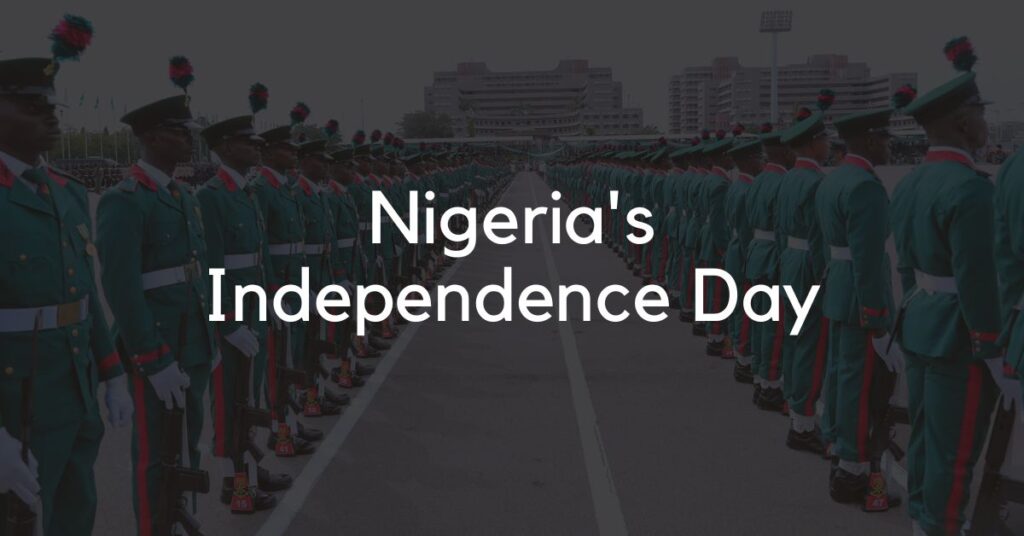
It is a national public holiday that is observed in all 36 states of the Federal Republic. Basically, Independence Day is when Nigerians mark the day they broke free from British Colonial rule back in 1960.
As the most populous nation in Africa and home to over 220 million people, Nigeria’s Independence Day is a spectacular occasion for Nigerians and the start of a stronger bond with a country to call their own.
Brief History on The Road to 1960
Independence Day may sound common to many who are ignorant of the long, winding road that led to it.
But it’s not.
Nigeria, as we know it today, is a British invention. In 1914, the British amalgamated the Northern and Southern protectorates to create a single administrative entity.
A territory that is vast enough to accommodate different ethnic groups, languages, and traditions under one colonial flag. It was a pragmatic decision made in London to shape Nigeria’s Identity for generations to come.
The Seeds of Nationalism and Self-Government
The British maintained firm control over Nigeria for decades until mid-century, when the struggle for freedom started making sense. As far back as 1923, Herbert Macaulay founded the Nigerian National Democratic Party, which gave Nigerians hope of something new, something which felt like light at the end of the tunnel.
Exactly 21 years later (1944), the National Council of Nigeria and the Cameroons (NCNC) was created and co-founded by Herbert Macaulay and Nnamdi Azikiwe. These early political movements planted the seeds of National consciousness that would be impossible to ignore.
Through the late 1940s and 1950s, the push for self-government and Independence became stronger in the hearts of the people. By the mid-1950s, it had grown louder and more unstoppable, especially after the Eastern and Western regions gained momentum to practice self-government in 1957. In 1959, the Northern region followed, and Nigeria embraced its own government.
Federal elections took place that same year to fully usher in Independence, but no single party won an outright majority. Sir Abubakar Tafawa Balewa had to form a coalition government as Prime Minister. Tafawa Balewa became a teacher, statesman, and the central figure in shepherding the nation towards its defining moment.
October 1st, 1960: A New Dawn
On Saturday, 1st October 1960, the Union Jack was lowered in Lagos, and a green-and-white flag was hoisted at 12:00 am.
It was surreal and felt like the weight of struggle, unending sacrifices, and dimmed aspirations were instantly melted into a symbolic act of strength. The event was held at the then Race Course in Lagos (now known as Tafawa Balewa Square) with over 40,000 people in attendance.
The constitutional instruments were presented by Princess Alexandra of Kent, who stood in for Queen Elizabeth II. The new federal government formally assumed authority immediately.
In his speech, Prime Minister Tafawa Balewa declared that day Independence Day and a date that should be remembered across generations. On October 1st, 1963, Nigeria became a republic, with Nnamdi Azikiwe as the first president of the Giant of Africa (Nigeria). Tafawa Balewa also retained his position as the Prime Minister and the most powerful figure in the Nation.
After independence came the turbulence that really shook the young nation. Military coups, a devastating civil war, and periods of authoritarian rule tested Nigeria as a nation.
Nonetheless, the troubles and turbulence couldn’t dim the significance of October 1st. It serves as a constant reminder of what Nigerians have fought for and what’s ahead to build.
How is Independence Day in Nigeria Celebrated Today?
Even after many decades, Independence Day remains one of the most anticipated dates on the Nigerian calendar.
Official Ceremonies
Every 1st October, the incumbent president of the Federal Republic of Nigeria gives a speech to commence the Independence Day celebrations.

The Nigerian national flag is raised simultaneously with the national anthem. It is usually a live broadcast on television and radio stations within the country. The president uses the occasion to discuss national challenges and list some government priorities. He sets the tone for the day and the stage is comfortable enough for citizens to celebrate.
After the speech, the president observes drills, inspects the guard of honour, watches parades, and a presidential change of guards performed by officers and men of the Brigade of Guards.
The official parade commences at noon, featuring marching bands and a lot of military fanfare, followed by a procession of traditional songs, dances, and outfits representing Nigeria’s ethnic groups.
Then, a tribute is dedicated to all our fallen heroes who stood and fought for the freedom Nigerians enjoy today. The cutting of a colourfully designed cake, which often carries the colours of the Nigerian flag, map, or coat of arms, takes place at Aso Rock (the Presidential Villa).
It doesn’t end there; the president of the Federal Republic of Nigeria then signs the anniversary register and releases white pigeons into the air as a symbol of freedom. This has been the pattern for many decades, a ritual that is so fulfilling for Nigerians.
The Public & Cultural Festivities
Independence Day celebrations don’t end with the official proceedings. Some schools participate in well-organized march pasts at their Local Government Areas.
Streets and homes are not left out. Most Nigerians wear the colours of the Nigerian flag (green and white) to add more colour to the day.
It is also a time to encourage unity among the nation’s 500 ethnic and linguistic groups, as well as the main religious groups.
Nigerians in the diaspora also find time to pause and reflect on their nation’s history and observe Independence Day with equal passion.
Independence Day in Nigeria is a reminder of the scars that birthed freedom. A story of resistance, resilience, and the enduring hope of a people determined to shape their future.
It’s a day that deserves to be celebrated by all.
FAQs on Nigeria’s Independence Day
FACT CHECK: We strive for accuracy and fairness in our content curation and reporting.If you see something that doesn't look right, please don't hesitate to contact us!
JOIN WHATSAPP COMMUNITY: Loved this post? You'll love our community more. Feel free to join our WhatsApp community today and be prepared to discover all of Abuja's best-kept secrets!